
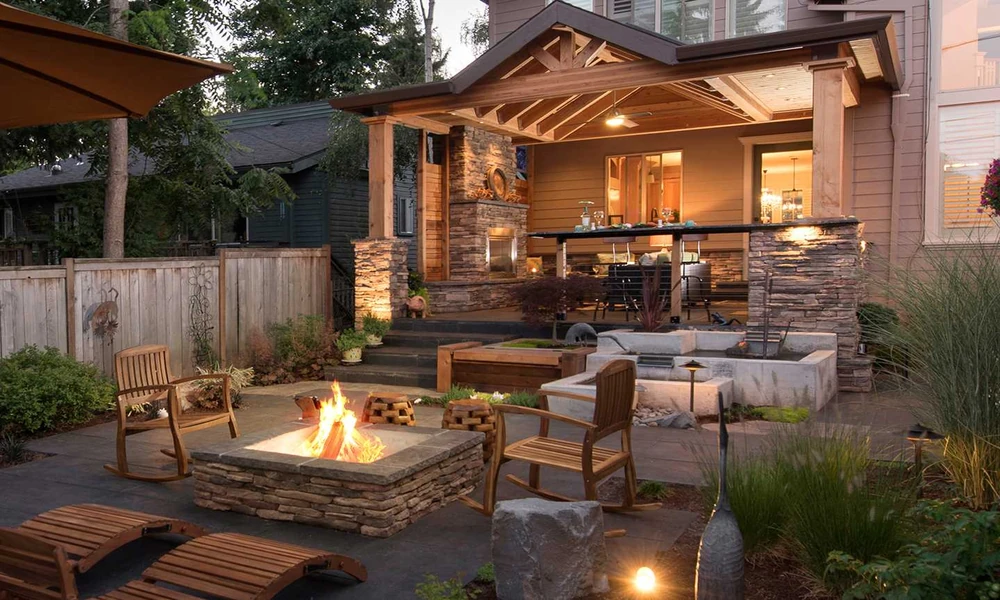
Picture a narrow backyard behind a semi-detached house in Laval. It measures about 30 feet deep and 20 feet wide, with a tired patch of lawn that turns to mud every April and a cedar hedge that hides the neighbours but also shades half the space by mid-afternoon. Thousands of families around Montreal know this kind of yard well. Most summers it gets mowed, hosts a barbecue or two, and is forgotten by October.
Now imagine the owners decide to stop fighting it. Their brief is short. They want somewhere to sit on cool evenings in May and September, a surface that survives snow piled on it for four months, and a look that doesn’t eat their weekends. They have a modest budget and no interest in hiring a full hardscaping contractor.
Starting with the ground, then the furniture
The first instinct in a project like this is to scroll Pinterest for patio sets and string lights. The smarter move is to decide what the ground will be made of, because everything else sits on top of it and has to work with it.
In this scenario, the couple compares a few suppliers and orders small samples to see how the colours behave in their own shaded yard. A supplier such as Stone Decorative, based in Boisbriand, ships 2 lb sample bags, which is enough to lay a patch on the lawn and look at it at 8 a.m., at noon and at dusk. Under the hedge, a warm beige stone that looked flat on a screen turns out to glow in the evening light, while a crisp white that seemed ideal reads almost blue in the shade.
That small experiment reshapes the whole plan. The shaded strip along the hedge gets a 2 to 3 inch layer of rounded beige pebbles over compacted soil, edged with steel. It replaces grass that never grew well there anyway. The sunny half keeps a smaller rectangle of lawn for the kids, and a compacted pad of crushed stone becomes the seating area, firm enough for chairs and a table but still permeable when it rains.
The fire feature changes the calendar
This is where the yard stops being a July-only space. Evenings in the Montreal region regularly dip below 10°C in early May and late September, based on Environment and Climate Change Canada climate data, and that chill is what sends most people indoors. A gas or propane fire table gives the seating area a reason to exist during those months.
The detail people overlook is the fill. The burner pan in most fire tables is covered with a base layer of lava rock and then topped with fire-rated stones or tempered glass. Only material designed for heat belongs there. Ordinary garden pebbles and river stones can hold moisture inside, and when that trapped water turns to steam, they can crack or split apart without warning. Fire stones rated for gas, propane or ethanol burners, or tempered fire glass, are the safe options. In this Laval yard, slate-gray fire stones tie the table visually to the dark steel edging and look intentional even when the burner is off.
That last point matters more than it sounds. For roughly five months, the fire table will be a sculpture under snow. Choosing a fill that looks good cold counts as a design decision in its own right.
Planning for snow, salt and the spring melt
Winter is the real test of any outdoor space in southern Quebec. Snow gets shovelled off the back deck and dumped on whatever sits next to it, which in this yard is the pebble strip. Stone handles that abuse better than almost any other surface. It doesn’t rot, compress or blow away, and when the pile finally melts in April, the pebbles are still exactly where they were.
A few precautions keep it that way. The bed is graded slightly away from the house so meltwater drains toward the back hedge instead of the foundation. Loose stones stay at least a shovel’s width from the deck stairs, where a plastic snow shovel would otherwise scatter them across the lawn. And no de-icing salt goes near the beds, since chloride buildup harms cedar roots and leaves a chalky residue on darker stones.
The owners also skip plastic landscape fabric under the planted areas. Leaves from the hedge would settle into the stone and root weeds straight through the fabric within two seasons. A thicker stone layer over firm soil does the same job without the tearing and patching later.
Spring cleanup becomes a twenty-minute job. Once the snow is gone, a leaf rake with its tines flipped upward pulls winter debris and gravel spray off the pebbles without dragging the stone onto the lawn. Anything that migrated during the winter gets swept back with a stiff broom, and the bed looks the way it did in October.
Small touches that make the space feel finished
With the ground and the fire table in place, the rest comes together quickly. A Weber kettle grill lives on the crushed-stone pad, well away from the lawn and the hedge. Three large boulders mark the transition between gravel and grass and double as extra seats when friends come over. A small bubbling fountain near the hedge masks some of the traffic noise from the boulevard, which in a dense suburb is worth as much as any plant.
Lighting does the rest. Low-voltage path lights along the pebble edge pick up the texture of the stones after dark, and a single warm strand of bulbs over the seating area keeps the mood casual. A couple of large planters with ornamental grasses soften the corners and can be swapped for evergreen boughs in December.
Nothing here is elaborate or expensive by renovation standards. Each choice simply supports one idea: this yard should be usable in more than one season, and it should look deliberate even when nobody is out there.
What the scenario shows
The lesson from this imaginary Laval yard applies to plenty of real ones across Quebec and the northern United States. Start with the ground. Test materials in your own light before committing to a colour. Choose a heat source that stretches the shoulder seasons, and think carefully about what the space will look like buried under a metre of snow. Furniture and décor come last, and they matter far less than most people assume.
A backyard that once got three months of use can reasonably give its owners seven. That is a better return than many renovations inside the house, and it starts with a few bags of stone and an afternoon of honest observation.
